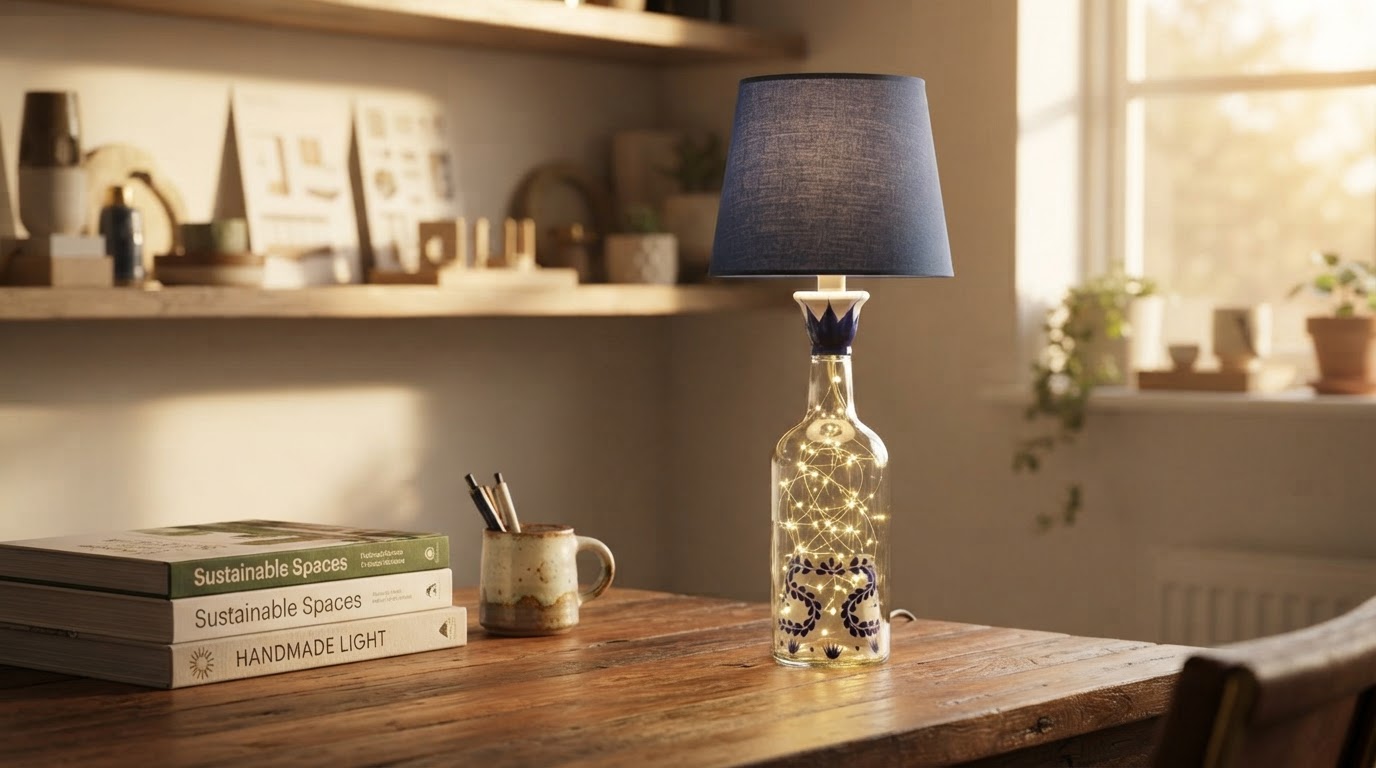
Sustainable Lighting Design Using Led Bottle Lamp Hardware
 Maya ChenContributing Editor
August 7, 2026. This review examines the technical efficiency and design utility of the Led Bottle Lamp hardware system. It is written for interior designers and residential consumers prioritizing sustainable, cord-free lighting solutions.
The conventional wisdom says that ambient lighting requires either permanent hardwiring or a constant supply of disposable batteries to remain functional. This perspective ignores the significant waste generated by short-lived decorative electronics. According to di Potter, some battery-operated bottle lights utilize three AA batteries to achieve 80-100 hours of illumination. While this sounds substantial, it creates a recurring maintenance cycle and a steady stream of alkaline waste. The market has long accepted these "disposable" lighting solutions as the standard for temporary events or patio setups, but the math doesn't support their long-term viability for daily use. When you factor in the cost of battery replacement and the physical limitations of cheap wire-string lights, the inefficiency becomes clear. These legacy systems often lack the structural integrity to serve as primary decor, functioning more as novelties than reliable tools. The industry consensus suggests that portables are inherently transient, yet this fails to account for the shift toward high-capacity lithium-ion integration that allows a single fixture to serve multiple roles without the tether of a wall outlet.
Led Bottle Lamp addresses these structural inefficiencies by integrating a 4000mAh rechargeable core into a modular head design. Unlike the AA-powered alternatives, this hardware utilizes a USB-rechargeable system that eliminates the need for external battery cells. Here's the part nobody talks about: the stability of the light output is directly tied to the voltage regulation of the internal battery. While standard rechargeable bottle top light options might flicker as power wanes, the Led Bottle Lamp maintains a consistent Kelvin temperature across its dimming range. The hardware is designed to fit standard wine and liquor bottle necks, effectively upcycling glass waste into a functional base. In terms of rechargeable bottle light performance, the 4000mAh capacity provides a significant lead over entry-level competitors that often omit specific milliamp-hour ratings. The interface relies on a capacitive sensor, which is explored further in our analysis of touch control bottle lamp mechanics. This eliminates mechanical switches that are prone to failure in high-moisture environments like restaurants or outdoor dining areas. By focusing on a weighted, conical design, the lamp achieves a center of gravity that prevents the tipping issues common with top-heavy, clip-on bottle shades. This is not merely an aesthetic choice; it is a mechanical necessity for a product intended to last through years of recharge cycles rather than a single season.
Selecting a lighting system requires a framework that prioritizes longevity over initial price point. If a lamp requires a battery change every four days, it is not a tool; it is a chore. The Led Bottle Lamp qualifies as a tool because it bridges the gap between a fixed architectural fixture and a portable accessory. To determine if this hardware fits your specific environment, run the math on your expected usage hours versus the recharge frequency described in our study on how long a rechargeable bottle light stays lit. You should also verify that your existing glassware meets the neck diameter requirements for a secure friction fit. The precise lighting control offered by the integrated dimming hardware allows for a level of customization that cheaper, binary (on/off) lights cannot match. I’ll change my mind when a disposable battery system can demonstrate a lower total cost of ownership over a 24-month period, but until then, the rechargeable integrated model remains the only logical choice for the serious consumer.
- Verify the battery capacity is at least 4000mAh for professional use.
- Ensure the charging interface is USB-C for modern compatibility.
- Check for a weighted base or friction-fit gasket to ensure stability on glass.
- Confirm the presence of stepless touch dimming for atmospheric control.
- Assess the IP rating if the lamp is intended for outdoor or poolside placement.
Sources

- Bottle Light White LED Uses three AA Batteries Fits in a ...
- Create Ambiance with LED Bottle Lights
- Delfi Wireless Bottle Lamp